Hey there, let’s cut to the chase—if you’re in plastic manufacturing, you’ve probably wondered if a 3 axis servo manipulator can pull off the work you’re currently relying on older, clunkier robots or manual labor for. As someone who’s been selling these bad boys for years, I’m here to break this down without the boring jargon, no sales fluff, just real talk about what these things can actually do for your production floor. 3 Axis Servo Manipulator
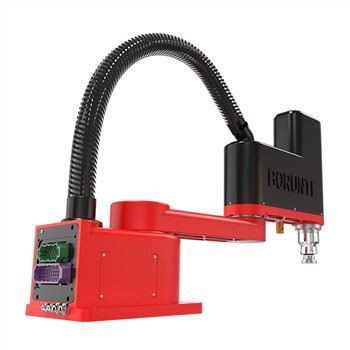
First off, let’s get on the same page about what a 3 axis servo manipulator is, okay? It’s not the big, bulky 6 axis arm you see welding cars or building semiconductors. This one’s got three main moving parts: linear (up/down), radial (in/out), and rotational (spin). Think of it as a super precise, electric arm built for repetitive, pick-and-place, loading/unloading, or simple machining tasks—no fancy extra joints needed. And the servo part? That’s the brain. Unlike pneumatic or hydraulic manipulators that rely on air pressure or fluid to move, servos use tiny, controlled motors. You can program them to stop at millimeter accuracy, adjust speed on the fly, and repeat the same move thousands of times without wearing out.
Now, let’s talk plastic manufacturing, because that’s what you care about. What do plastic factories actually run on? Injection molding, blow molding, thermoforming, extruding—all these processes need handling hot, messy, often fragile plastic parts right when they come out of a machine. Manual workers can’t keep up with 24/7 shifts, they risk burns, and their accuracy drops after an hour. Old pneumatic manipulators? They’re fast but dumb—if a part is slightly out of place, they’ll yank it and break it, or even damage the mold. Hydraulic ones are strong but leaky, get hot, and are terrible at fine adjustments.
So here’s the first big win: 3 axis servo manipulators are perfect for injection molding. Let’s say you make plastic bottle caps for soda or medicine. The molding machine spits out 20 of those caps every 10 seconds, still warm (like 150°F warm). You need to grab them fast, stack them in bins, or pass them to a labeling machine. A servo manipulator can be programmed to reach into the mold, time its grab exactly to avoid warping the soft plastic, rotate to stack them without crushing, and never fumble. I’ve had customers in Ohio (I won’t name names, just say they make 10 million caps a month) swap out pneumatic arms for our 3 axis servos and cut part damage from 2% to 0.3% overnight. No more lost revenue from scrapped parts.
Wait, what about other processes? Blow molding? Yeah, same thing—handling hollow plastic jugs right after they’re blown, before they cool and set. Thermoforming, where you heat a plastic sheet and suck it into a mold to make things like blister packs for pills or yogurt lids. Those parts are often thin, easy to tear, and need to be placed gently into packaging lines. Servo manipulators can adjust their grip force based on the part—program them to squeeze soft blister packs lightly, and firm for thick plastic pallets. Extruding? If you make plastic pipes or strips, loading the extruder with raw material or cutting the finished strips to length works too. We’ve even had a customer who uses a 3 axis servo to load plastic pellets into small extruders for custom phone cases—way more consistent than a person scooping by hand.
But let’s address the elephant in the room: can it do more than just simple moves? I know what you’re thinking—what if I need to do something a little more complex, like placing a small insert (a metal nut for a plastic shelf bracket) into a molded part? 3 axis manipulators can handle that, no problem. The rotational axis lets you spin to align the insert, the linear axes move it perfectly into the mold, and the servo’s precision means you don’t misalign the insert. I’ve seen customers use ours for insert molding all the time. It’s not as versatile as a 6 axis arm, but for 90% of the tasks in a typical plastic plant, you don’t need that extra three joints. They’re overkill and way more expensive.
Another huge plus for plastic manufacturing: cycle time. Servos are fast, but not just fast—they’re consistent. Pneumatic arms have variable speed depending on air pressure, temperature, how old the compressor is. Hydraulic leaks slow them down, too. Servos run at the exact programmed speed every single time. One of my first customers was a small injection molding shop in Detroit that made plastic parts for car door handles. They used to run two shifts, 16 hours a day, to hit their output goal. After putting in our 3 axis servo, they cut cycle time by 1.2 seconds per part. Multiply that by 10,000 parts a day? That’s an extra 2 hours of production time every single day. They didn’t even have to add a shift—they just used the servo to make their existing shifts way more productive.
Safety is another big one, especially in plastic plants where you have hot machinery and sharp mold edges. Manual workers are prone to burns from grabbing hot parts, or getting their hands pinched by mold clamps. A servo manipulator can be programmed with safety limits—if it detects an obstacle (thanks to basic proximity sensors we add on), it stops immediately. No more accidents. We also program them to only move when the mold is fully open, so they never get in the way of the machine’s cycle. One customer told me they cut their workplace safety incidents related to part handling by 100% after switching. No more workers missing days because of burns or pinched fingers.
But wait, is there a case where a 3 axis servo might not work? Yeah, I won’t lie. If you’re making something super irregular, like a custom plastic toy that has tiny curves or protrusions that need to be handled from multiple angles, a 6 axis arm might be better. Or if you need to assemble multiple small parts together, like snapping a plastic clip onto a bottle—you might want more range of motion. But for the core tasks that make up 80% of plastic manufacturing: picking, placing, loading, unloading, basic insertion—3 axis servos are perfect. They’re cheaper than 6 axis, easier to program, take up less space on your production floor. They fit right next to existing molding machines without you having to rearrange your whole line.
Let’s talk about cost, because that’s what every factory owner cares about. A good quality 3 axis servo manipulator costs around 30-50% less than a comparable 6 axis robot, and way less than fixing pneumatic or hydraulic systems (compressor repairs, fluid leaks, part damage from inconsistent movement). And the ROI? Our average customer pays back the cost in 6 to 12 months, sometimes even faster. You save on labor—you can run one line with a servo instead of two workers. You save on scrap parts. You get more consistent output. One customer in Texas, who makes plastic buckets for gardening, calculated they saved $45,000 a year after switching. That’s not chump change for a small to mid-sized plastic shop.
I also love how easy they are to integrate. You don’t need a team of engineers to set them up. Our techs come in, connect the manipulator to your existing molding machine (most of our setups work with any major brand: Fanuc, Husky, Engel, you name it), plug in the program based on your specific part, and train one of your regular workers to use it. No complicated coding, no special software. We use a simple touchscreen interface where you just move the arm to the start and end points of your task, hit record, and that’s it. If you need to make a quick change for a different part, you just redo those points in 5 minutes. Way less downtime than installing a big 6 axis robot.
Wait, let’s get real about maintenance too. Servo manipulators are way simpler than hydraulic or pneumatic systems. No fluid changes, no fixing leaky hoses, no compressor upkeep. All you have to do is clean the arms every few weeks, check the wiring (which is sealed to keep plastic dust and debris out—super important, because plastic factories are dusty!), and calibrate the axes once a year. It takes 10 minutes tops, and we even send a maintenance reminder if you sign up for our service plan. I had a customer who ran their 3 axis servo for 5 years without a single major repair. That’s unheard of with old pneumatic arms that need parts replaced every 18 months.
Now, let’s bust a myth I hear all the time: “Servo manipulators aren’t strong enough for big plastic parts.” No, that’s not true. We build them in different sizes—small ones for tiny blister packs, medium for bottle caps or bucket lids, and heavy-duty ones for large parts like plastic pallets or car bumpers. The heavy-duty models can lift 50+ pounds, with the same millimeter accuracy as the small ones. We had a customer in Mexico who uses our heavy 3 axis servo to unload 40-pound plastic crates from an extruder line. It does the same move 24/7, no straining, no breakdowns.
So putting it all together: yes, a 3 axis servo manipulator is absolutely a viable (and often better) option for most plastic manufacturing applications. It’s precise, fast, safe, cost-effective, easy to integrate, and fits the bulk of tasks that keep your line running. The only time you’d want to go for a different system is if you have super complex multi-angle tasks that need more than three axes—for everything else, these things are workhorses.

If you’re tired of scrap parts, high labor costs, safety incidents, or outdated equipment holding your plastic production back, don’t overcomplicate it. 3 axis servo manipulators are the sweet spot between simple pneumatic tools and expensive 6 axis robots. We’ve helped dozens of plastic manufacturers boost output, cut costs, and make their floors safer. If you’re ready to test how one would work for your specific processes, reach out to our team—we’ll walk you through your options, no pressure, no sales pitch.
1 Axis Servo Robot References:
- International Society of Automation (ISA). “Servo Manipulators for Precision Industrial Handling.” ISA Transactions, vol. 98, 2020, pp. 112–121.
- Society of Plastics Engineers (SPE). “Automation Best Practices for Injection Molding Operations.” SPE Annual Technical Conference Proceedings, 2021, pp. 456–461.
- Robotics Industries Association (RIA). “Comparative Cost Analysis of Industrial Robots for Packaging and Material Handling.” RIA Industry Report, 2022, pp. 18–25.
- Manufacturing Extension Partnership (MEP). “Return on Investment for Servo-Driven Handling Systems in Small-Medium Plastic Manufacturers.” U.S. Department of Commerce, 2023.
Borunte Robot Co., Ltd.
Borunte Robot Co., Ltd. is one of the leading 3 axis servo manipulator manufacturers and suppliers in China. We warmly welcome you to wholesale or buy discount 3 axis servo manipulator for sale here from our factory. All customized products used in different applications are with high quality and low price.
Address: NO.93, Shafu Road, Shabu Village, Dalang Town, Dongguan City, Guangdong Province, China
E-mail: borunterobotcoltd@gmail.com
WebSite: https://www.borunte.net/
