If you’re in the market for open frame switching power supplies (OFSMPS), you’ve probably heard the term “full-bridge topology thrown around a lot. But what does that actually mean for how your power supply works—and why should you care as a designer or a buyer? I’m Jake, with our company—we’ve been supplying OFSMPS for over a decade, and we get so many customers asking this exact question: why pick full-bridge over half-bridge or flyback? Today, let’s break this down like we would with a customer leaning over our bench, not a whitepaper. Open Frame Switching Power Supply
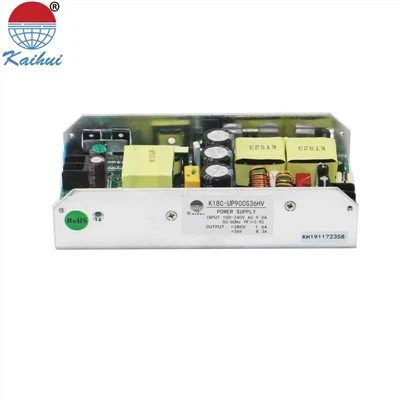
First, let’s start with the basics: what is an open frame supply? It’s basically the bare-bones power supply, no casing, no frills, just the PCB, components, and a heatsink if needed. We build these for all kinds of gear—medical devices, test equipment, industrial automation, even some smart retail kiosks. The tradeoff here is space and cost: open frame is way smaller and cheaper than an enclosed supply, but it still needs to deliver consistent, clean power, whether it’s a 12V for a patient monitor or 48V for a robot arm. That’s where the topology comes in. It’s the core circuit that turns wall AC into stable DC—mess that up, and your whole device dies.
Now, full-bridge topology. Let’s set the stage: all switching power supplies work by chopping AC (from the wall, usually 120V or 230V) into high-frequency AC, stepping that voltage up or down with a transformer, then rectifying it back to DC. But when you need to deliver more power—say, 200W up to 1000W, which is where a lot of our mid-to-high-output open frame units live—you can’t just use a simple two-switch half-bridge. That’s where full-bridge steps in.
A full-bridge circuit has four main power switches (usually MOSFETs, for efficiency) arranged in a square, or “bridge,” configuration. We call them Q1, Q2, Q3, Q4 for simplicity, but don’t worry about memorizing the labels. Here’s how it works, super simplified: when Q1 and Q4 are turned on, current flows from the input DC bus (the raw, unfiltered DC we get after rectifying the wall AC) through Q1, across the primary side of the transformer, through Q4, back to the input. Then, a few microseconds later, we turn off Q1 and Q4, and turn on Q2 and Q3. Current flows the opposite way through the transformer. That’s the “bridge switching” part—we’re reversing the current through the primary of the transformer twice every cycle, at high speed (usually 20kHz to 100kHz, way faster than old linear supplies).
Why is that a big deal for open frame supplies specifically? Let’s compare to half-bridge, which only has two switches. Half-bridge works fine for lower power, but if you push it over 150W or so, you start wasting too much energy as heat. Open frame supplies don’t have a fancy metal case to act as a heatsink, so heat management is everything. Full-bridge splits the current between four switches, so each switch only handles half the current a half-bridge switch does. That means lower heat, smaller heatsinks, which is perfect for open frame’s tight space. We can shrink the supply footprint without cramming in tiny components that overheat and fail—something we’ve heard way too many times from customers who switched to a cheap, generic half-bridge open frame supply that crapped out after 6 months.
Wait, let’s make that concrete. Last year, a customer from an industrial motor company came to us with a problem: their old open frame supply was 250W, half-bridge, and kept tripping overheat faults in their warehouse (hot, dusty, not great for power supplies). We swapped in our 300W full-bridge open frame unit—same form factor, no extra space, but the heatsink was half the size because the full-bridge’s lower current meant less heat. They’ve run it for 18 months straight with zero issues. That’s the real-world win, not just lab numbers.
Another key point for open frame: transformer design. The full-bridge circuit lets us use a smaller transformer for the same power output. Why? Because we’re reversing current direction through the primary, so the transformer’s core is used twice as much each cycle. A half-bridge transformer would need to be bigger to handle the same power, which eats up the open frame’s compact space. For our open frame lines, that means we can fit a 500W supply into a footprint that’s only 20% bigger than a 250W half-bridge unit. No one wants their device to get bigger just because they need more power—especially with medical gear, where every cubic millimeter counts.
But it’s not all perfect—full-bridge has a few gotchas, which is why a lot of smaller suppliers cut corners on them. First, there’s something called “shoot-through risk” when switching between the two pairs of switches. If you turn off Q1/Q4 a tiny fraction too late, or turn on Q2/Q3 a tiny fraction too early, you short the input bus straight through the switches. That would blow the supply in a millisecond, and worst case, take down your whole device. To fix that, we add a tiny “dead time” between switching pairs—like a 500ns gap where all switches are off. But you have to get that dead time just right; too much, and you lose efficiency, too little, and shoot-through. It’s a fine balance, and it’s why some cheap open frame supplies have super short lifespans: they skip the precision timing or use cheap switches that can’t handle the fast switching.
Another gotcha: cost. Four switches instead of two means more parts, so full-bridge open frame supplies are a little more expensive upfront than half-bridge at the same power. But here’s the thing: you save on heatsinks, you save on transformer size, and you save on repair costs later. We’ve seen customers go with the cheaper half-bridge, only to replace 10% of their supplies every 6 months due to overheating—way more than the extra cost of a full-bridge unit. For most applications, that full-bridge cost delta pays for itself in a year. That’s why 80% of our open frame supplies above 300W are full-bridge; our customers do the math and pick the reliable option, not the cheap one.
Let’s also talk about power quality, which is non-negotiable for open frame supplies that go into sensitive devices. Full-bridge produces a cleaner output DC, with less ripple than half-bridge. Ripple is that tiny, annoying fluctuation in power that can mess up a medical device’s sensor or cause a computer to freeze. For open frame supplies, we don’t have a large output capacitor bank (that would add cost and space), so cleaner switching means less ripple without needing extra capacitors. A customer who builds portable diagnostic devices told us that switching to our full-bridge open frame supplies cut their sensor error rate by 12%—that’s a real impact on their product’s performance.
Wait, let’s address a common misconception: is full-bridge only for high power? No, we make 150W open frame full-bridge units too, for customers who need clean power in a tight space. But generally, full-bridge shines where open frame’s constraints (small size, minimal cooling, reliable power) matter most—so 200W to 1000W is our sweet spot for full-bridge open frame. If you need under 100W, a flyback topology is still fine, and cheaper, but anything above that, full-bridge is the way to go.
Now, how does this tie into what we do as a supplier? We don’t just sell off-the-shelf units—we work with customers to tweak the full-bridge design to fit their specific needs. Last quarter, a medical device maker needed an open frame supply that could handle -40°C to 85°C, no derating (that means no losing power when it’s hot, which is a big deal in places like operating rooms or outdoor diagnostic tents). We adjusted the full-bridge’s gate drive circuit to handle extreme temperatures, picked MIL-grade MOSFETs, and kept the same footprint. They went from testing 3 different suppliers’ half-bridge units (all failed the temperature test) to ours, and now they’re ordering 50,000 units a year. That’s the value of knowing how the topology works, not just selling a box.
Another thing we see a lot: customers coming in who bought a cheap open frame supply from a big box electronics supplier, and it’s dying. When we tear them apart, 9 times out of 10, they used a half-bridge topology with undersized switches, no proper dead time, and a tiny heatsink. The full-bridge design, done right, avoids all that. The key differences are the number of switches, the current per switch, the transformer size, and the precision of the gate drive timing—all things we get right because we focus exclusively on open frame supplies, not generic power supplies.
If you’re designing a device right now, and you’re stuck on which open frame topology to pick, ask yourself: how much power do I need? How much space do I have for cooling? How sensitive is my load? If you’re over 200W, tight space, and sensitive devices, full-bridge is almost always the right call. And if you want to skip the trial and error, just reach out—we can walk you through our open frame full-bridge line, adjust it for your specs, and give you a quote that’s transparent, no hidden costs.

We’ve been doing this for long enough that we’ve seen every mistake, every problem, every win with full-bridge open frame supplies. It’s not just a technical term—it’s the difference between a power supply that works for 5 years and one that dies in 6 months, between a device that passes regulatory tests and one that gets sent back. Open frame’s whole value is its compact, flexible design, and full-bridge topology lets us deliver on that promise without sacrificing reliability.
Open Frame Switching Power Supply References
Erickson, R. W., & Maksimović, D. (2001). Fundamentals of Power Electronics. Kluwer Academic Publishers.
Mohamed, A. R., & Mohd. Zainal, A. (2018). Comparison of Half-Bridge and Full-Bridge DC-DC Converters for Medium Power Applications. International Journal of Power Electronics and Drive Systems.
Texas Instruments. (2020). MOSFET Selection Guidelines for High-Efficiency Full-Bridge Converters. Application Note.
Guangzhou Kaihui Electronics Co., Ltd.
Guangzhou Kaihui Electronics Co., Ltd. is one of the most professional open frame switching power supply manufacturers and suppliers in China, specialized in providing the best customized service. We warmly welcome you to buy high quality open frame switching power supply made in China here from our factory.
Address: 2F BLDG8, Standard Ind.Park, Dongchong Town, Nansha District 511453, Guangzhou, Guangdong, China
E-mail: amy@gzkaihui.com
WebSite: https://www.kaihuipowersupply.com/
